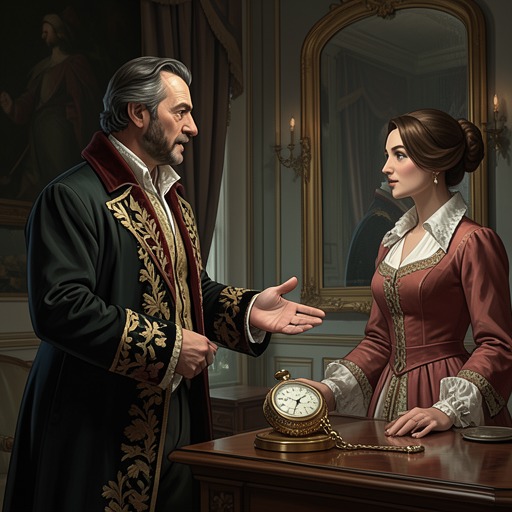
Porthos and Madame Coquenard love relationship
The Three MusketeersPorthos and Madame Coquenard love relationship is built on a deliberate social fiction. Porthos speaks of Madame Coquenard, the wife of an attorney of the Châtelet, as though she were a great duchess or princess, while using the relationship to obtain money and support. The affair therefore joins romantic vanity to practical dependence: Porthos wants to appear a favored gentleman, and Madame Coquenard wants to preserve the privileges and illusions of a lover who treats her as a great lady.
The Grand Lady Behind the Title
The relationship is first seen through the eyes of an innkeeper who has discovered that Porthos’s supposed duchess is not a princess at all, but Madame Coquenard, an attorney’s wife who is at least fifty and lives in the Rue aux Ours. The contrast between the title Porthos gives her and the ordinary social reality of her home exposes his method. He enlarges the affair through language, converting a financially useful liaison into a romance of rank, while the location and her age quietly undermine the picture of aristocratic splendor.
The innkeeper’s knowledge comes from a letter Porthos entrusted to him for delivery. Rather than placing it in the post, he sent one of his lads to carry it directly to the woman, believing this to be safer and more faithful to Porthos’s wish for secrecy. Madame Coquenard received the letter in a passion, calling Porthos a weathercock and declaring that he must have received his wound for another woman. Her jealousy gives the relationship an emotional dimension, but it also reveals how precarious Porthos’s performance is: the supposed duchess is not merely a source of funds but a possessive lover who watches for signs of betrayal.
Money, Injury, and Dependence
Porthos’s attachment becomes most visible when his material situation deteriorates. After receiving seventy-five pistoles, he invited a traveling gentleman to play at dice. He lost the entire sum and, in the same reversal, lost his horse as well. The episode exposes the gap between his outward confidence and his actual dependence on others. He can perform the careless magnificence of a Musketeer, but a brief run of bad luck leaves him in urgent need of assistance.
Porthos consequently wrote to Madame Coquenard asking her to send about fifty louis, claiming that he was absolutely in need because of his accident. When no answer came, he sent a second, more pressing letter. He imagines that she must be away at her country seat, but the silence also suggests the limits of the relationship’s reciprocity. Porthos expects rescue as part of the privileges of being her favored man; Madame Coquenard, however, can withhold the money and make his grand persona suddenly helpless.
His dependence is sharpened by the fact that he cannot leave his chamber because of his wound. The innkeeper’s account of the letter accidentally reveals both the injury and the lover’s anxiety. Madame Coquenard interpreted the message as evidence that Porthos was a weathercock and feared that the wound had been caused by another woman. Her jealousy transforms financial support into a bargaining relation: Porthos needs her money, while she needs reassurance that her investment in him has not been displaced by a rival.
Performance, Secrecy, and Comic Exposure
Porthos does not simply deceive strangers; he recruits his companions into the fiction. The supposed duchess is part of the identity he displays to d'Artagnan and the wider social world. The revelation that she is an attorney’s wife turns his boastful title into comic evidence of class performance. His romance depends on the distance between what he says and what others can discover, and the innkeeper’s decision to deliver the letter personally collapses that distance.
The affair also belongs to a broader pattern of disguises and exaggerated identities in the novel. Porthos’s social fiction is less dangerous than the deceptions surrounding political missions, but it operates through the same mechanism: a name or title invites belief until an object, place, or witness exposes the truth. The Rue aux Ours becomes an anticlimactic setting for the grand romance, and Madame Coquenard’s angry reaction supplies the proof that Porthos’s rhetoric has been masking a real, unstable attachment.
Yet the exposure does not destroy Porthos’s confidence. When he recounts his gambling losses, he speaks with the most careless air in the world and quickly turns the conversation toward d'Artagnan. His composure is part of his survival strategy. Even when his horse and seventy-five pistoles are gone, he continues to behave as though misfortune were an ornament of his gentlemanly life rather than a threat to his existence.
Affection and Material Exchange
The relationship is neither reducible to pure love nor separable from material exchange. Madame Coquenard’s jealousy indicates genuine emotional investment, while Porthos’s letters make his financial expectations unmistakable. He seeks fifty louis because he knows that her affection can be converted into practical aid. The relationship thus resembles a private system of credit in which charm, secrecy, attention, and promises circulate alongside money.
Its asymmetry is central. Porthos receives the prestige of having a great lady, even though that prestige is fictitious, and expects her to bear the cost of his equipment and accidents. Madame Coquenard receives the emotional claim of being treated as a duchess and the possessive rights of a lover, but the narrative presents her as the materially stronger party whenever Porthos requires funds. Her anger at the letter shows that she can punish his infidelity not merely through reproach but through refusal.
The comic force comes from Porthos’s simultaneous dependence and vanity. He wants to be seen as a man supported by aristocratic devotion, yet the woman behind the title is a wealthy attorney’s wife whose resources sustain him. His relationship with Madame Coquenard therefore makes visible the economic underside of masculine honor: the splendid appearance of the Musketeer rests, at moments, on a woman’s money and on his ability to conceal that fact.
Narrative Significance
Porthos and Madame Coquenard love relationship gives the Musketeer’s public magnificence a private and comic foundation. It explains why an apparently grand lover can be suddenly unable to pay his debts, replace a horse, or equip himself, and it turns his claims of aristocratic favor into a source of embarrassment as well as advantage. The affair also reinforces the novel’s recurring contrast between appearance and reality: a duchess is an attorney’s wife, a romantic attachment is a financial dependence, and a boast of fortune conceals immediate poverty.
At the same time, the relationship humanizes Porthos without making him modest. His vanity, gambling, wounded pride, and confidence all remain intact, but they are placed within a network of obligations that he cannot command by bravado alone. Madame Coquenard’s jealousy and possible refusal to answer his letters demonstrate that the relationship has its own power over him. For all his theatrical self-presentation, Porthos must wait for the favor of the woman he calls a great lady.